Micro and Macro Dimensions of a World at War in the Art of Lesia Vasylchenko and Kateryna Aliinyk
This is the translation of the interview I recorded last summer with
Lesia Vasylchenko and Kateryna Aliinyk for The Art Newspaper.
It was published in Italian on July 24, 2025.
Founded in 2006, the PinchukArtCentre is dedicated to amplifying the voices of contemporary Ukrainian art, both nationally and internationally. Its contribution to cultural promotion extends across Europe’s major artistic platforms. In parallel, the PAC pursues an intensive research program that retraces the history of Ukrainian art from the 1980s to the present. This commitment takes concrete form in the Research Platform, freely accessible, whose digital archives can be consulted by scholars and researchers worldwide.
The centre also promotes two biennial prizes for artists under 35: the internationally oriented Future Generation Art Prize, and the PinchukArtCentre Prize, dedicated exclusively to Ukrainian talents. The most recent edition of the Prize unfolded against a broad reflection on the context of the Russian invasion and its multiple repercussions on both private and institutional spheres since February 2022.
I had a chat with Lesia Vasylchenko and Kateryna Aliinyk, respectively winners of the Main Prize and the Special Prize. Lesia’s work, dense with lyricism and speculative depth, explores cosmological questions of time and its militarised dimension. With Kateryna, instead, I share origins in Luhansk, in the Donbas region. Her art articulates, with painterly intensity, the contested memory and pain of our land.
In the jury’s statement, the night was described as a space of melancholy. I see it instead as a space of aggression and danger. What is there in your night?
L.V. The Ukrainian night is a central element of national culture. In literature, painting, and poetry, it has crystallised as an archetype: everyone knows the sense of the Ukrainian night. But since the full-scale invasion, it has ceased to be a romantic myth, transforming into a space of terror and a weapon of war. Most attacks occur at night; surveillance, thermal imaging, and drones make it possible to see the enemy, and whoever “sees” dominates. Darkness becomes a tactical instrument; the night is militarised.
Your work also seems to address the construction of the algorithm of historical narrative, or am I mistaken?
L.V. With the Enlightenment, knowledge replaced faith and became associated with light; many newspapers are called The Day or The Dawn. Today, however, overwhelmed by information, we find ourselves once again asking whom to believe. Knowledge returns to being an act of faith.
My work explores what remains invisible in media, culture, and war. The night thus becomes a space that escapes control and dominant narratives. It is not merely the absence of light, but a refusal of codified knowledge. In the dark, what is uncertain, unfinished, still unformed comes into being: a memory in the making, where voices, archives, and stories that remain unseen survive.
The Ukrainian night is a historical condition that safeguards versions of the past still submerged. In an increasingly militarised present, it becomes a space of possibility.
What, then, is the new way of looking at history?
L.V. Agamben wrote that the stars we see are the light of extinguished celestial bodies. The cosmos is already traversed by the light of new stars, but we cannot see it because it is still travelling toward us. Like the sky, history is a space-time: events illuminate us only after they have been documented and narrated.
What we see is a past already organised and made visible. But history also preserves what was never filmed, archives never opened, voices left unheard. What remains in the shadows is invisible yet real, waiting to emerge.
Derrida spoke of history as a “trace”: absent in the present, yet present as a ghost. The past lives on as removed, unwritten narratives, excluded for political reasons, because historical linearity itself is a political construction.
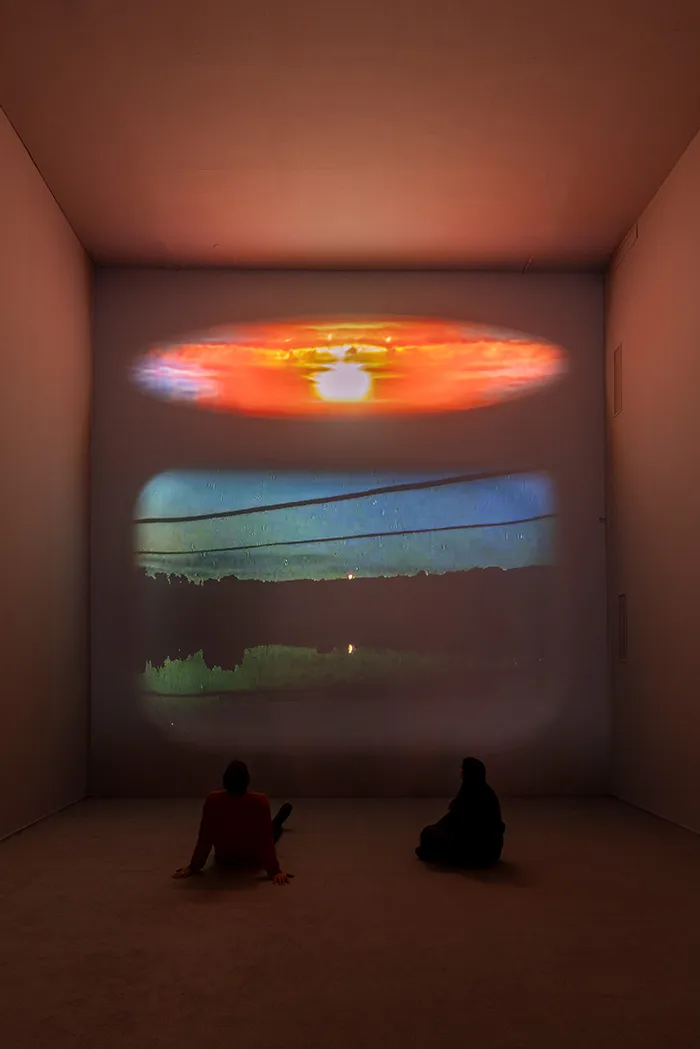
Lesia Valylchenko, Night Without Shadows and Light Without Rippling of Waves, 2022–2025. Above: Tachyoness, 2022, video, 8’00’’.
I know you are moving away from the theme of the Donbas landscape. You write about blades of steel among blades of grass. What does this mean?
K.A. The series created for the competition marks a provisional farewell to the Donbas theme. The last time I was there was in 2019; since then, that place has become almost entirely imaginary. To continue working on it would seem dishonest to me, hence the melancholy of the artworks.
Blades of Grass with Blades of Steel is a title charged with emotion. Fresh grass evokes innocence and purity, yet my memory of home is poisoned by war. The time before 2014 no longer appears whole. Speaking of Luhansk or the Donbas today is difficult, too much ambiguity and pain. The blades on the grass speak of a desire for innocence, but also of constant danger.
In this series of canvases, many animals and insects appear. Why has your once static landscape become so populated?
K.A. Listening to Lesia, I understood that war, for me, is no longer a matter of knowledge, but only of faith. This is how animals appeared in these paintings: war returns us to a cyclical time, governed by the alternation of day and night, and forces us to feel like instinctive creatures. The night is ferocious; the day, bearable.
The season becomes an existential condition. Summer brings an illusion of happiness, autumn nourishes and prepares, but winter looms with its terror. Like mice in the fields, we too fear we may not survive.
And when the missile passes beyond us, a wild joy arrives at death annulled. It is something profoundly animal; I had never felt anything like it before.
The work All Their Life Is Still Ahead of Them! depicts a metre of earth inhabited by insects and mice. For us it is nothing; for them it is everything. A world that desires only to live, while History continues to crush us for eleven years now.
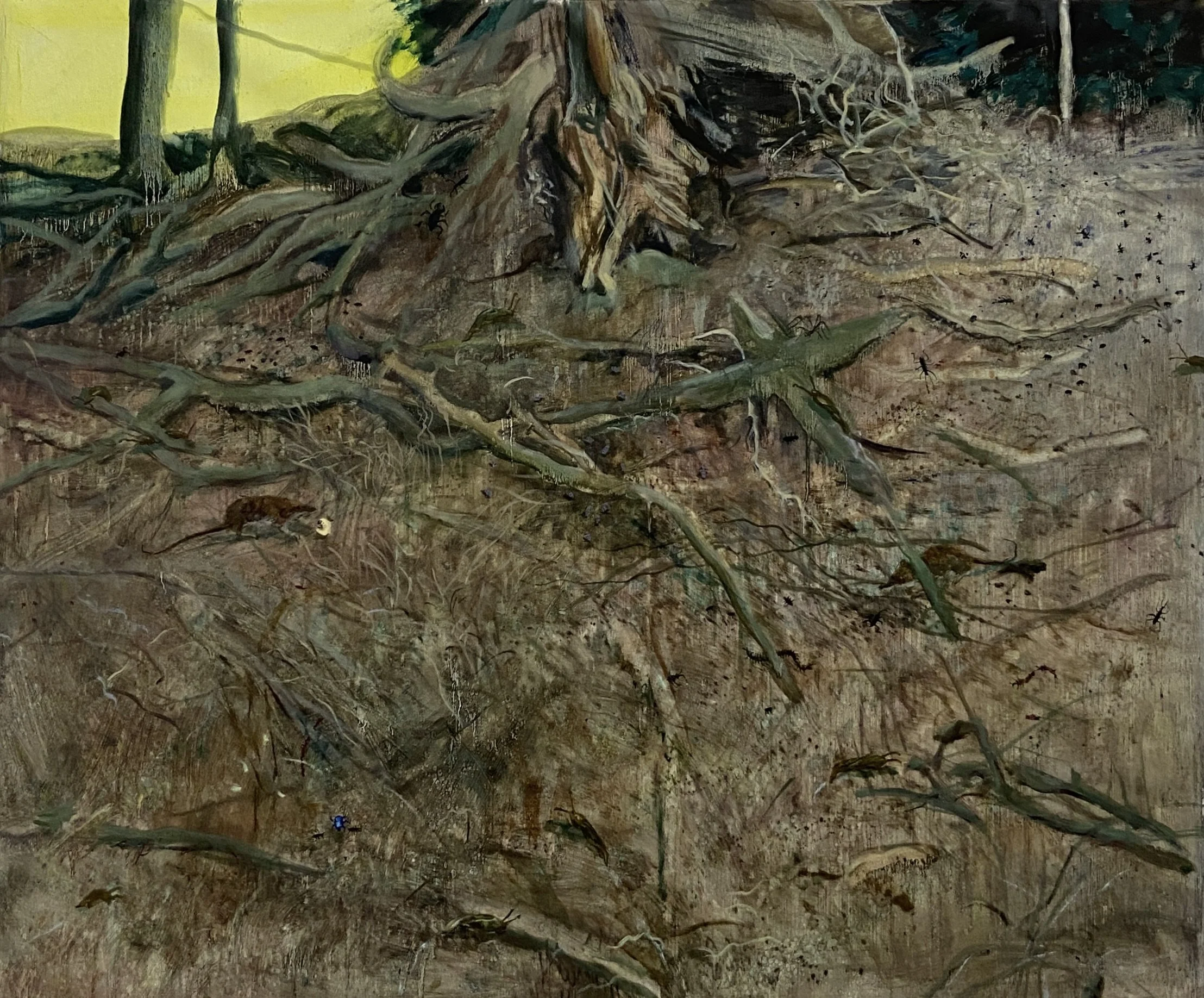
All Their Life Is Still Ahead of Them!
In these works, the question of freedom emerges forcefully, as the titles suggest.
K.A. Freedom is just another way of saying that you have nothing left to lose—this foggy landscape with wild boars expresses it. War has brought me back to essential themes: life, death, love, and freedom. Before, I had no voice; now I think: if not now, when? Yet freedom here is bitter, losing one’s home is a freedom different from the one we had imagined.
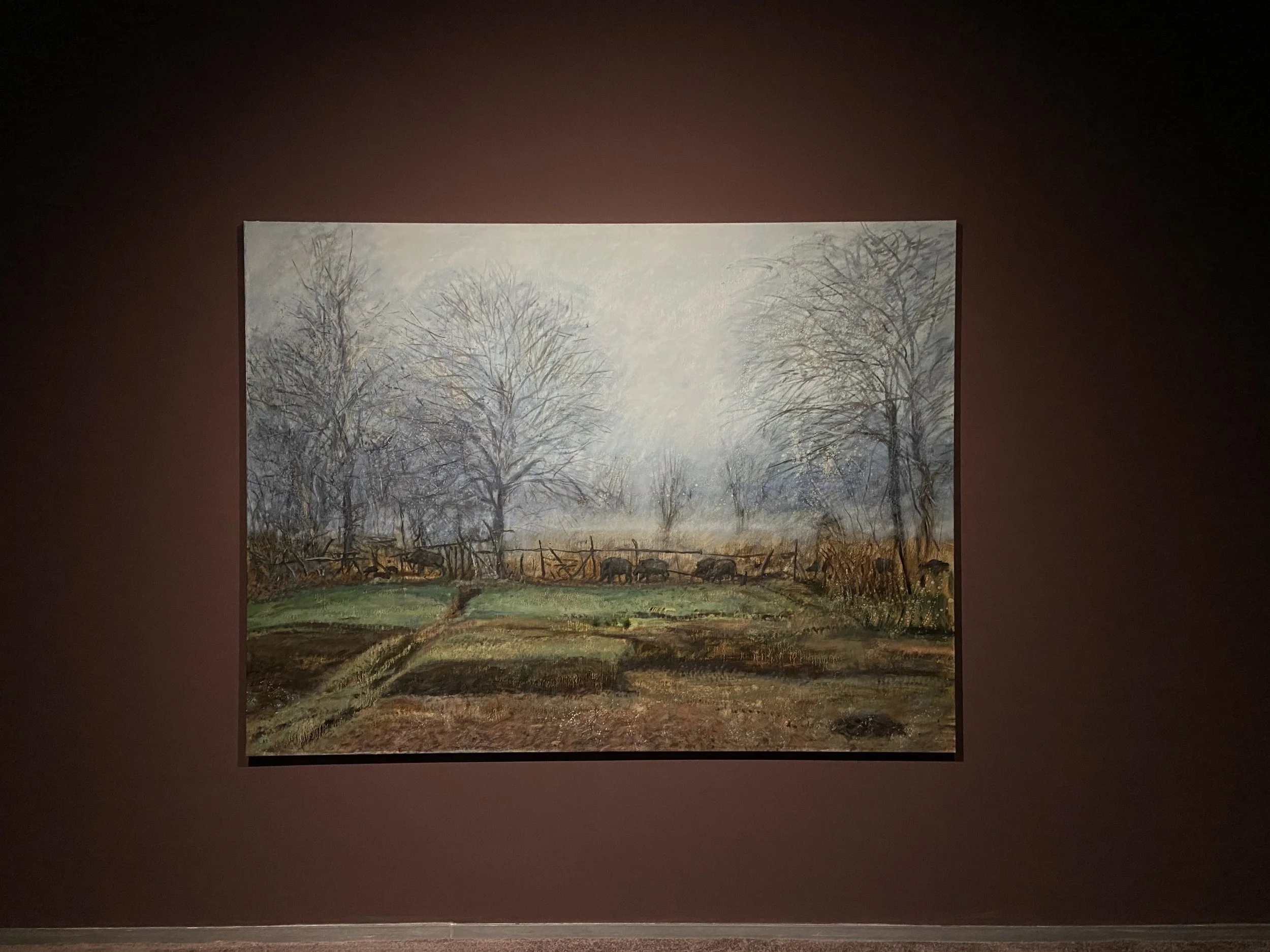
Freedom is just another way of saying that you have nothing left to lose.
The smallest canvas, The Dream Came True!, shows insects on the Moon. Today, I feel my identity is more tied to landscape than to culture, which is unstable, while nature is eternal. The Moon is that of Dürer and Munch, the trees those of Bruegel. In that painting, a childhood dream is fulfilled: insects reach the Moon.
The question remains: do I truly live as I love? It is sad that this seems like a secondary question. In one painting, beetles that love humidity dry out in the sun: they do not do what they love. As in Dante’s fire that falls like snow, nothing lives as it would wish. Everything loves something, but today we cannot even ask ourselves what that is. Perhaps this is the greatest tragedy.
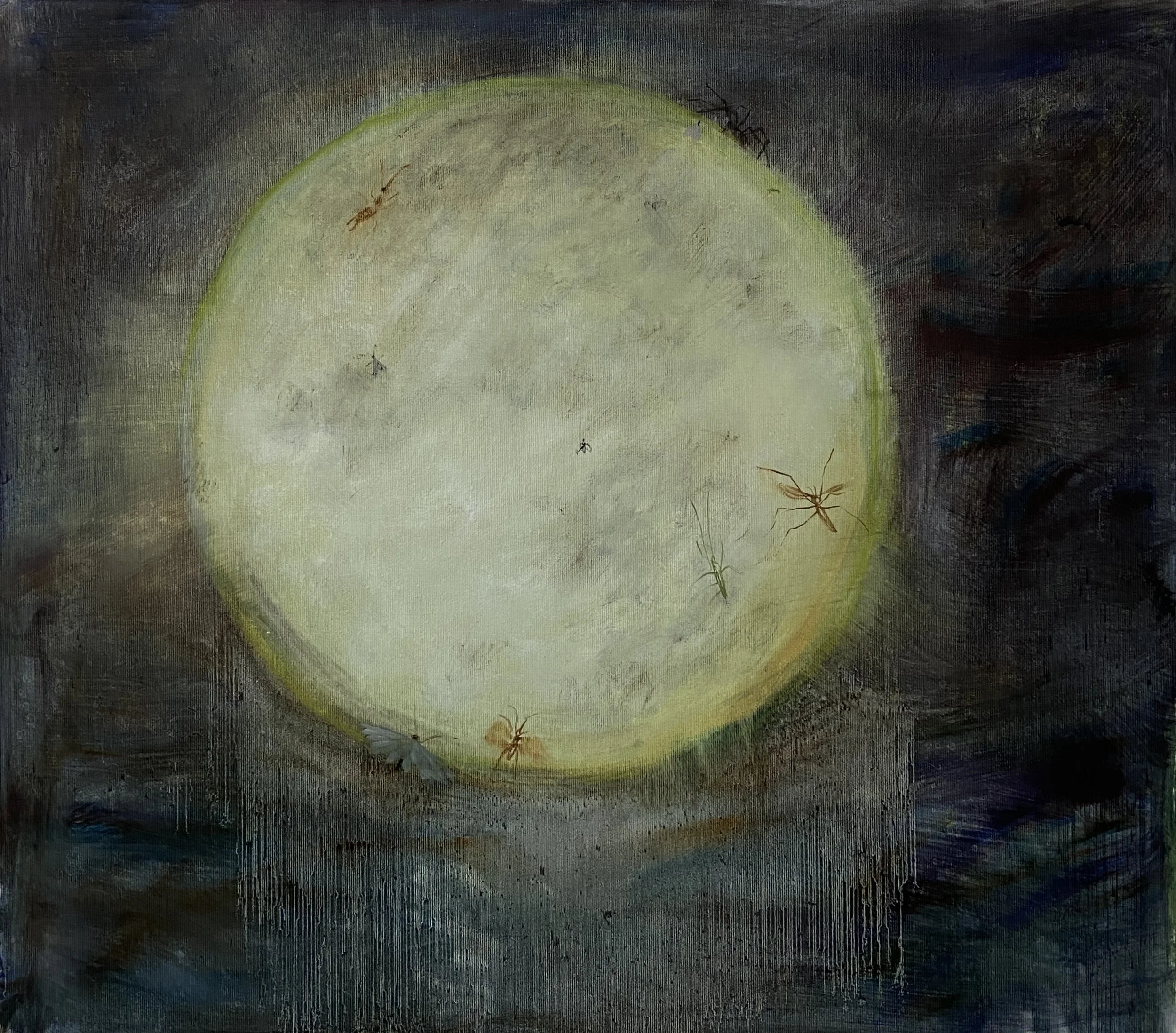
The Dream Came True!
I find it difficult to comment on all of this. I would like to say that one day I will find the right words, but I am not sure I will.
L.V. May I do it?
Of course.
L.V. I now understand that both bodies of work speak of human measure. Where is the human being situated in this reality? There are tiny insects that live for only a day, yet manage to reach the Moon, symbol of the eternal.
Both works explore the contrast between the infinitesimally small and the immensely large, between the extremely brief and eternity.
The human figure, ideally placed between these two poles, embodies the fragility of human time.
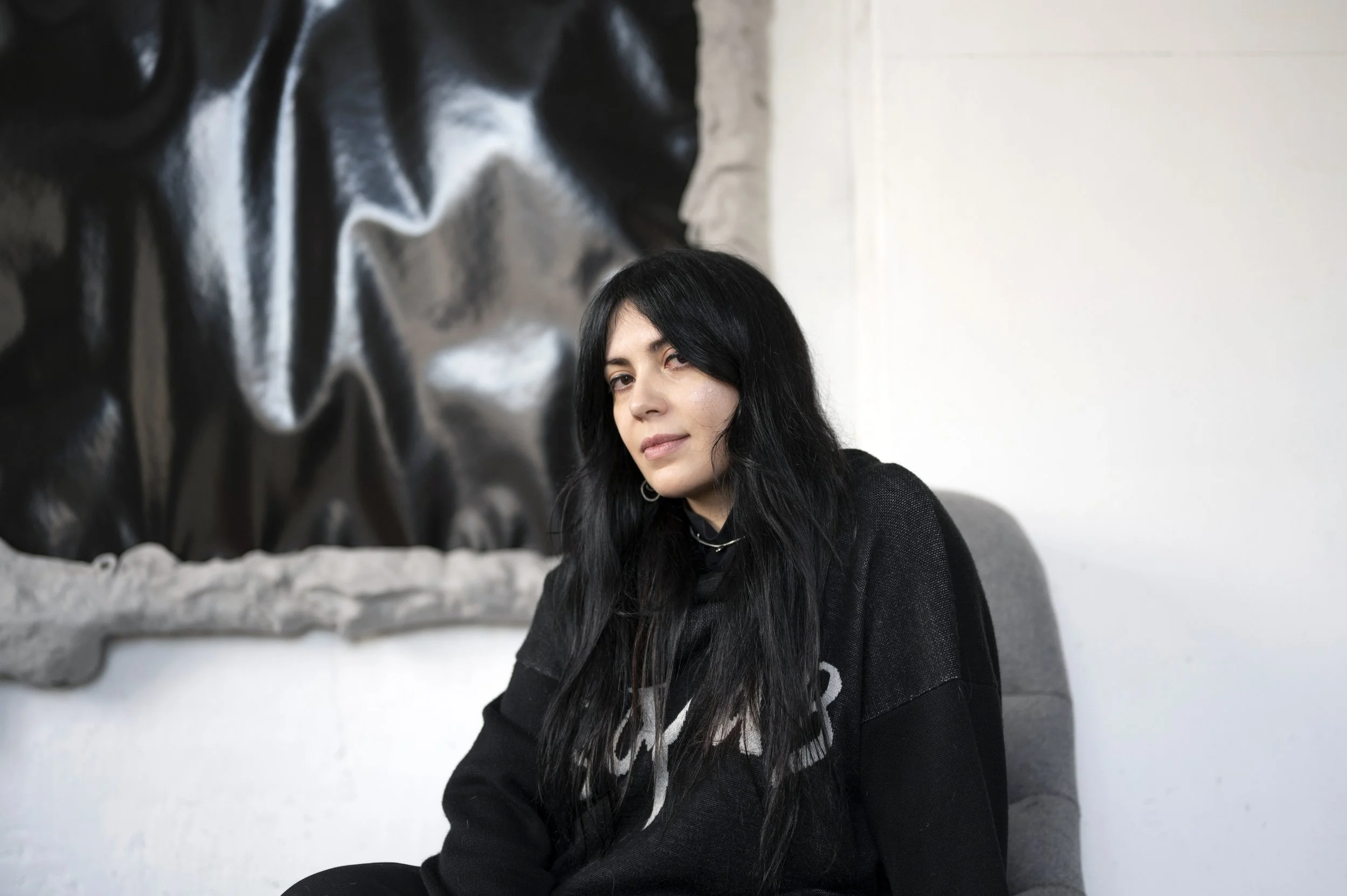
Lesia Vasylchenko (born in Kyiv, Ukraine) is an artist and a researcher. Her practice spans video, photography, and installation, focusing on the intersections of visual culture, media technologies, and chronopolitics. She develops speculative terminology such as "Tachyonic Data" (Onassis Publications) and "Chronosphere" (Institute of Network Cultures) to critically explore temporality, more-than-human time, and technologies of vision. Vasylchenko is the founder of STRUKTURA.Time, an interdisciplinary initiative bridging visual art, media archaeology, literature, and philosophy. Vasylchenko holds a degree in Journalism from Taras Shevchenko National University of Kyiv and a degree in Fine Art from the Oslo National Academy of the Arts. Her work has been shown, among others, at the Museum of Modern Art in Warsaw, MUNCH Museum, Henie Onstad Art Center. She received the Sandefjord Kunstforenings Art Award (2023), the PinchukArtCentre Prize Main Award (2025) and is currently nominated for the Future Generation Art Prize (2027). Her work is part of the collection of the Museum of Contemporary Art KIASMA / Finnish National Gallery in Helsinki, Finland.
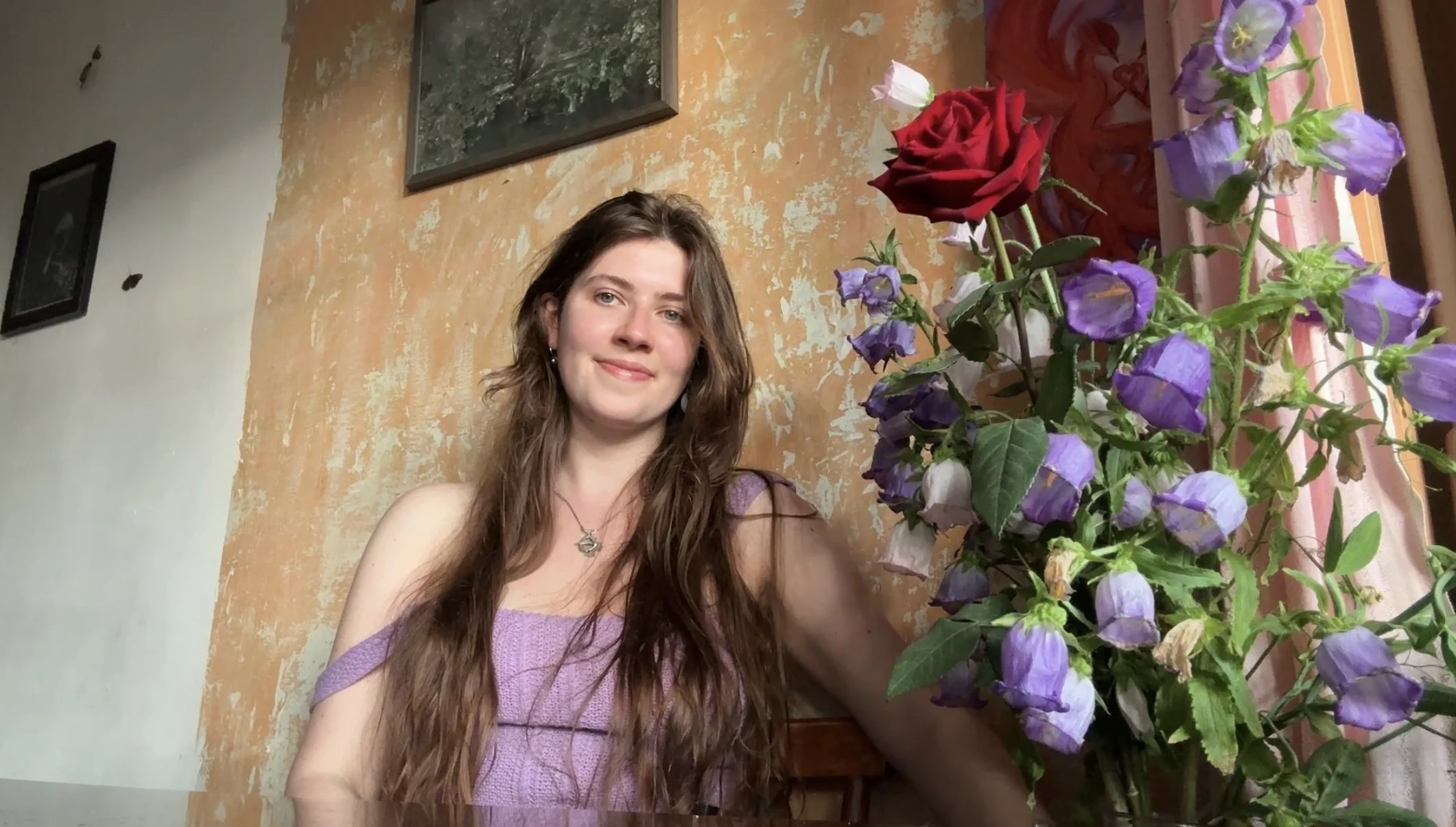
Born in 1998 in Luhansk, Ukraine. Focused on painting, Kateryna Aliinyk also works with text, creates objects and installations. She is one of the most interesting voices on the contemporary Ukrainian art scene. The main topics of her art are war and the occupation of Ukraine as well as their consequences depicted through imagery and metaphors of nature and non-anthropocentric optics.
A graduate in painting of the National Academy of Visual Arts and Architecture in Kiev (2021), she has also completed contemporary art courses at the KAMA Kyiv Academy of Media Arts and at the Method Fund (both in 2020). Artist-in-residence at the Centre for Contemporary Art Ujazdowski Castle (2022).
Kateryna Aliinyk’s works have been exhibited worldwide, including Ukraine, Poland, Ireland, Hungary, Germany, Austria, Italy, UK and Romania.
In 2024 she was invited to the From Ukraine: Dare to Dream exhibition organised by the PinchukArtCentre, which accompanied the 60th International Art Exhibition La Biennale di Venezia, Italy. In June 2025 she won the First Special Prize at the PinchukArtCentre Prize 2025 for the Blades of Grass with Blades of Steel project.
